Notes on The Architectonic of Hegel's Phenomenology of Spirit, by Jon Stewart
Philosophy and Phenomenological Research, Vol LV, No 4, Dec 1995
I came across a footnote in Pippin’s Hegel’s Idealism mentioning a 1973 work by Otto Pöggeler, Hegels Idee einer Phänomenologie des Geistes which I can’t read due to my knowledge of German being limited to the insult “Shattenparker”, but managed to find this article by philosopher Jon Stewart that mentions Poggeler’s work a bit and also treats the same topic.
I provide some summary notes on the article here, much of the denser parts actually tracing the parallels between the various chapters are not summarized in any kind of detail, since doing so would amount to basically just copy-pasting or needlessly retyping-in-sort-of-own-words Stewart’s own arguments.
If you want to read the original, you can create a free account on JSTOR which limits you to up to 100 articles per month, which is very generous for a dabbler and probably even sufficient for a serious student.
- the “general belief among scholars today is that at bottom Hegel’s philosophical project as a system is simply bankrupt and indefensible all around” (747). This was written in 1995, does it still hold? I suspect mostly is the answer.
- “The Phenomenology is thus seen simply as an eclectic and at times bizarre collection of atomic analyses on sundry topics. This preconception of the Phenomenology as a disunified text then leads to a predetermined and, in my view, erroneous interpretive approach” (747-748).
- This has lead some scholars to just give up on trying for a systematic approach/interpretation and instead treat it like a supermarket, picking and choosing what seems interesting and cogent, but this obviously runs counter to Hegel’s own insistence on “systematic nature of philosophy as an intellectual enterprise” (749).
- We clearly do Hegel a “disservice” (750) in sifting through his philosophy for the bits we like, but arguably Hegel brought that on himself and is not so controversial; Stewart must make the argument not just that Hegel wouldn’t have like our approach, but that it is fundamentally wrong. “If we are going to talk about Hegel at all, we must also talk about the Hegelian system” (750), no, we only must do this if his systematic approach is right, which is wholly unclear. I’m sympathetic to Stewart’s direction overall but he overstates his case here for no good reason.
- In an 1807 letter to Schelling Hegel “claims that the work contains an intricate ‘interlacing of cross-references back and forth”16 that he unfortunately was unable to make as clear as he would have liked” (750-1).
- Stewart’s goal is to defend the formal unity of the Phenomenology. He explicitly rejects efforts similar to his that attempt to transpose the structure of Hegle’s Logic back onto the Phenomenology. Stewart intends to “linger” (751) on the sections devoted to Reason, since they are the key, he writes.
- He begins with the the Table of Contents, which anyone who has attempted to read this book will agree is seriously fucked up (my words, not Stewart’s). I vaguely recall encountering this for the first time and it making me see in a new light how absurd and arbitrary-seeming were Kant’s table of categories, though K’s attempt to impose that structure was not so seemingly bizarre as Hegel’s. Apparently this is partly the fault of various editors, who have tried to coalesce two different organizational schemes into one, as Hegel changed his mind on the structure during/after its composition. This should not be seen as a stain on the unity of the text itself, says Stewart, and I agree.
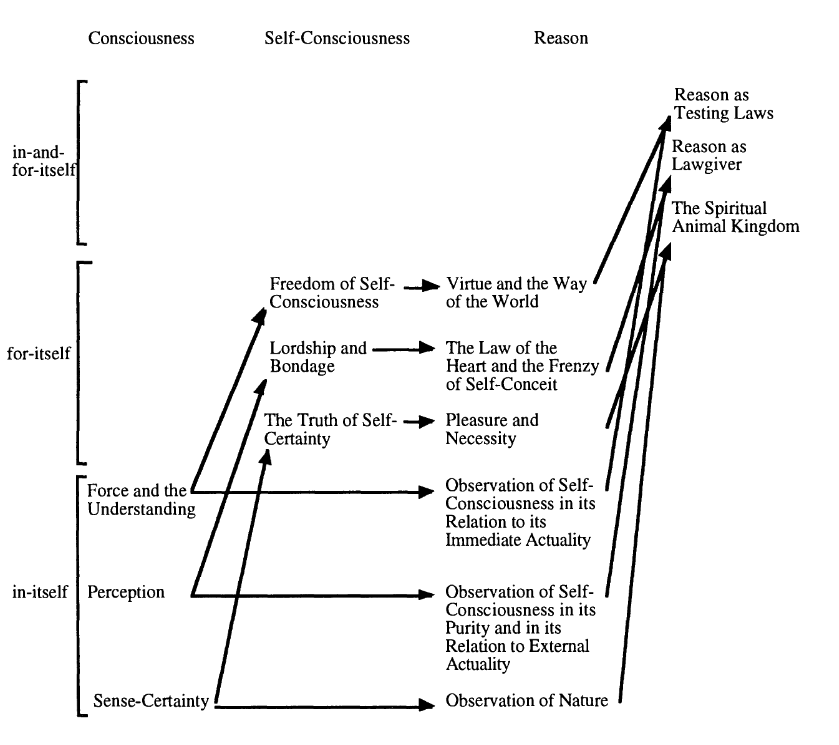
- Stewart says that what Hegel meant to convey with the single vs double letters is two parallel structures: “Consciousness” and “Self-Consciousness” are meant to run their course in a fashion parallel to one another. On the other hand, what he indicates with the double letters is that the dialectic is to return to the beginning; thus, “Reason,” “Spirit” and “Religion” return to the same starting point that we saw in “Consciousness” and work through the same material again under different aspects in accordance with the sphere that each governs. The important point for our purposes is that Hegel’s revision of the table of contents is a welcome aid to those searching for a key to the systematic unity of the work” (754).
- The “Consciousness” chapter (objects, in-itself) leads to the “Self-consciousness” (subject, for-itself) unproblematically, and run parallel to each other: “The analyses in the ‘Consciousness’ chapter that are given with respect to individual objects are then in ‘Self-Consciousness’ reapplied to the self-conscious subject” (755). We begin to run into trouble with the internal structure of the “Self-consciousness”, though. Other chapters are ordered into 3 subsections, but here we only have two: ‘A. Lordship and Bondage’ and ‘B. Freedom of Self-Consciousness’ (754).
- Stewart contends that the material preceding the Lordship and Bondage section, which some have seen as merely introductory, is actually the first argumentative step in the Self-Consciousness chapter, and Stewart says he will refer to this part as “The Truth of Self-Certainty” (756). As evidence in support of this reorganization, Stewart offers: 1 Hegel did the same reorganization in his Encyclopedia, 2 he also did the same thing in his 1808-11 Philosophical Propaedeutic, 3 a structural parallelism between with the chapter on Consciousness becomes apparent if we follow Stewart’s suggestion (757).
- “The structure of ‘Reason’ is somewhat problematic due to its inordinate length, which seems to set it apart from the ‘Consciousness’ and ‘Self-Consciousness’ chapters. However, this length is only troublesome if we consider the ‘Reason’ chapter as a whole to correspond to ‘Consciousness’ and ‘Self-Consciousness’ respectively as seems to be indicated by Hegel’s first table of contents. If, on the other hand, we see ‘Reason’ as going back to the beginning of the dialectic and working through the same material as ‘Consciousness’ and ‘Self-Consciousness’ at a higher conceptual level, then the problem disappears since ‘Reason’ would then correspond to ‘Consciousness’ and ‘Self-Consciousness’ taken together and not as individual units” (758-9). Stewart claims this is the whole point of the single vs double letters, and that interpreting things thus clarifies their otherwise confusing usage (759). The Reason chapter must be longer because it reworks all the material from the previous two (760). The next several pages work this out in detail, there is not much point in me reproducing the course of their argument.
- He does have a nice chart from p 765 which I include a screenshot of here:
- What now are we to make of the Spirit section? In the Reason chapter we got an account of a community but it was abstract or general, in a Kantian sense; to get beyond that, we must examine particular/concrete ethical and social situations and figures (767).
Stewart provides another useful chart here:
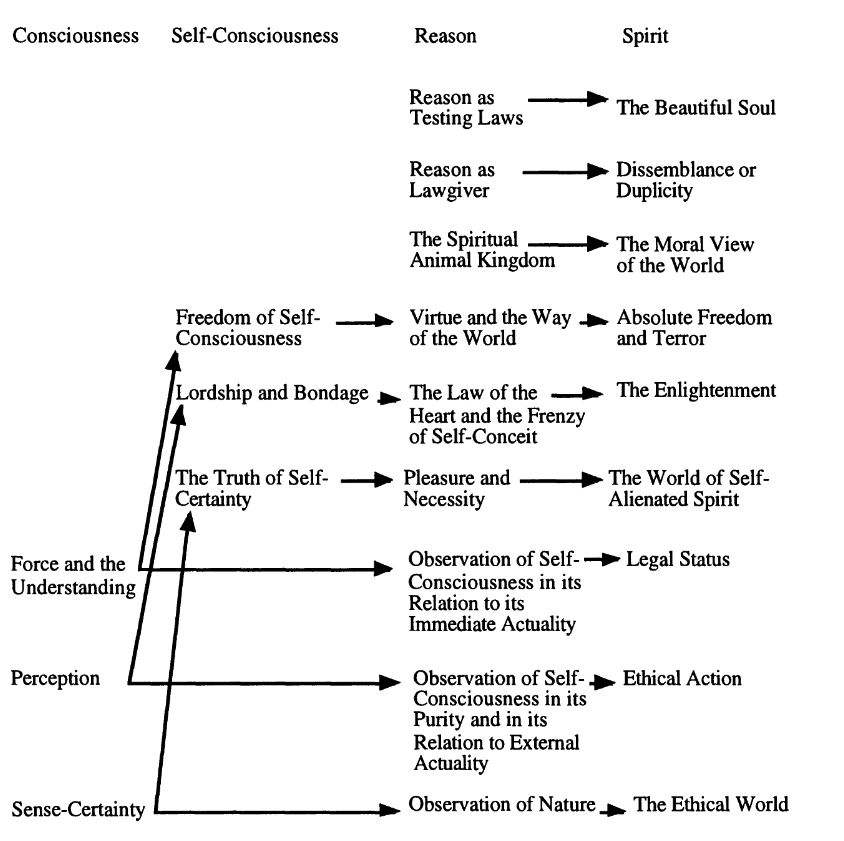
- Following the progression of simpler to more complex, “‘Religion’ likewise represents a more complex configuration than what we saw in the ‘Spirit’ chapter” (770). “Hegel indicates at the beginning of ‘Religion’ that the parallelisms that we have been following up until now will continue in this chapter” (771), in this chapter we will run through the same forms again but this time, H says, atemporally instead of temporally (771) as these are moments of Geist which “have no existence in separation from one another” (771).
This allows Stewart to complete his chart
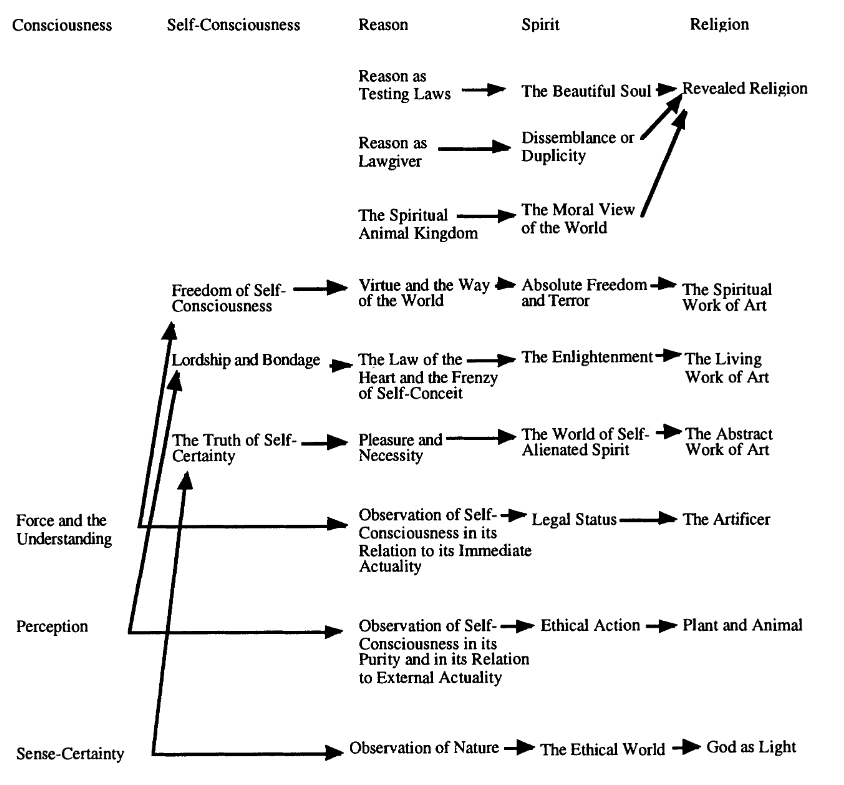
- Religion has the same content as philosophical knowledge (Absolute Knowledge), H says, although expressed metaphorically (774). Absolute Knowing is not knowledge of some set or of all particular facts, but the “panoptic overview of all previous Notions… the grasping of the various forms of thought as a whole” (775).